
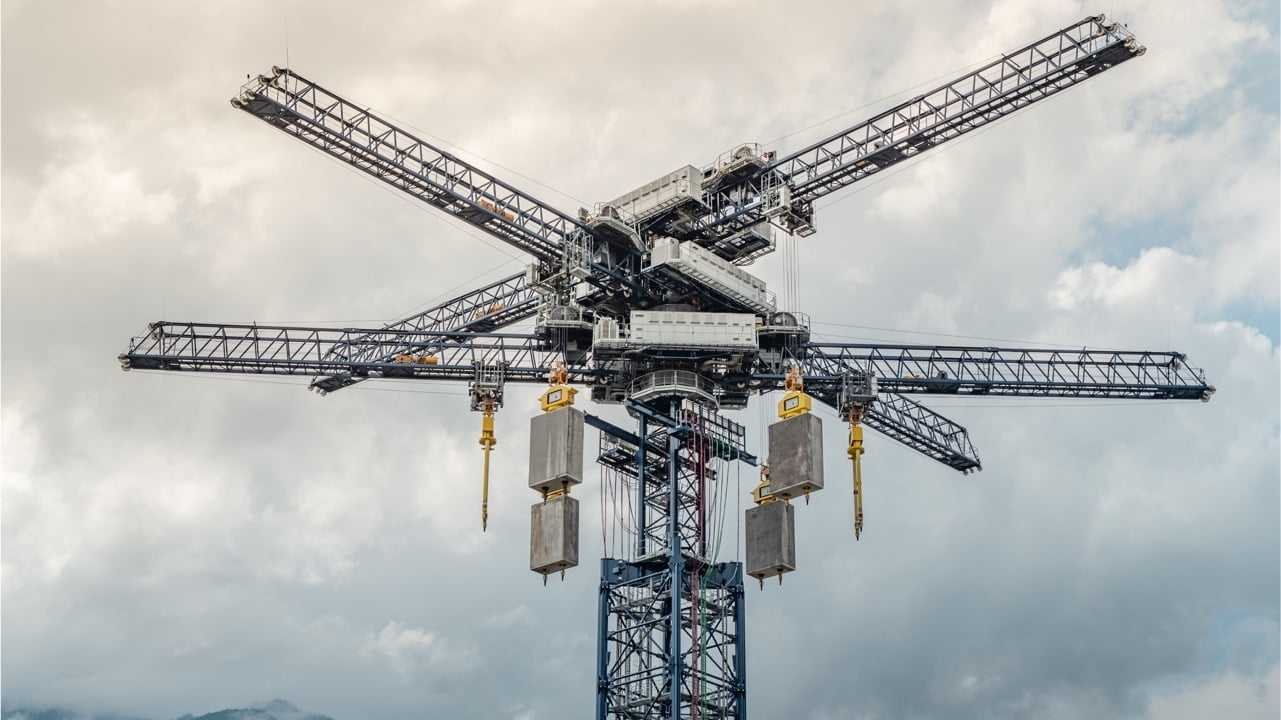
Introduction
In an era of increasing shift towards renewable energy, a significant challenge has appeared: what to do when there’s no sun or wind? Right now, we often rely on old-school methods like burning fossil fuels, which doesn’t really match our clean energy goals.
That’s where gravity batteries come into play. Imagine using extra energy from sunny or windy days to lift a huge weight up. When the weather doesn’t cooperate, we let that weight fall, and as it drops, it generates electricity. It’s a simple idea, but it’s pretty smart.
History of gravity batteries
The journey of gravity-based energy storage isn’t a concept born of the 21st century. In fact, its roots can be traced to 1907, when the world saw the first gravitational energy storage in the form of pumped storage hydroelectricity in Switzerland.
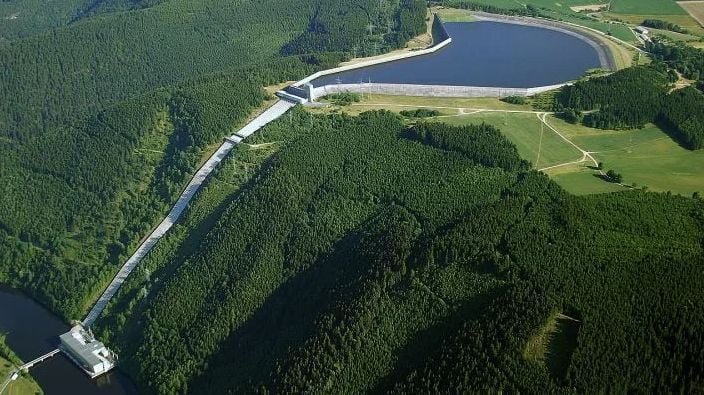
This method, revolutionary for its time, utilized off-peak energy to move water to higher elevations, later using this stored potential energy to generate electricity on demand.
Today the principle of gravity storage has evolved to the contemporary iteration – gravity batteries – no longer confined to the use of water and elevation changes, it offers a promising solution to the intermittency of solar and wind energy.
How gravity batteries work
When we generate more renewable energy than we can use – think of a particularly windy day or unusually sunny hours – we need a way to save that surplus energy. Gravity batteries will use this excess energy to power a system that lifts a massive weight. This weight, once raised, holds potential energy, much like water held behind a dam.
Now, let’s say the wind dies down or it’s nighttime, and our renewable sources can’t generate enough power. The gravity battery releases the weight, which falls under the force of gravity. As it descends, it drives a generator, converting potential energy back into electrical energy we can use. The transition from storage to power generation is swift, allowing the system to adapt to energy demands in real time.
The key components of a gravity storage system include the weight, lifting mechanism, and generators.
Unlike chemical batteries that degrade over time, the physical components of a gravity battery provide a longer operational lifespan with minimal maintenance.
Advantages of Gravity Batteries
- Scalability: Gravity batteries can be scaled, from small community projects to larger grid-scale applications.
- Geographical Independence: Unlike pumped hydro, gravity batteries don’t require specific landscape features to work. They can be implemented in a wide range of environments, including urban areas or repurposed industrial sites like decommissioned mines.
- Longevity: Gravity batteries have a longer lifespan with high efficiency over time. Since the system relies on mechanical movement rather than chemical reactions, wear and tear are significantly reduced.
Examples
Companies leading the charge for such an innovation are Gravitricity and Energy Vault – they aim to demonstrate that gravity batteries can offer reliable, cost-effective energy storage solutions.
Gravitricity’s innovative approach utilizes old mine shafts to house their gravity battery systems, turning abandoned industrial spaces into sources of green energy.
Energy Vault, on the other hand, takes to the skies with tower-based systems that can be built anywhere, showcasing the adaptability of gravity battery technology.
Gravity batteries are cost-effective, proving to be at least two times cheaper than their lithium-ion counterparts. The cost of storing a single megawatt-hour with gravity batteries averages around $171, compared to $532 required for sodium-sulfur batteries and $274 for innovative flow batteries.
Conclusion
Gravity batteries are very promising solution of storing renewable energy. They’re flexible, meaning they can fit into all sorts of places, from the heart of a city to the depths of an old mine. They’re also kind to our planet, using simple mechanics instead of harmful chemicals to store and release energy. Plus, they’re built to last, offering a long-term solution without the need for frequent replacements or repairs.